Bruce Coleman Mortgage Brokers

604-688-6002

Reasons to Avoid FSBO (For Sale by Owner) – Consult with a Vancouver Mortgage Broker

Canadian Mortgage News

CMI 101 Series

Dreyer Group 101 Series

First Time Buyers

Home Buying 101

Latest News

Mortgage Rates

Refinancing

Self Employed

Reasons to Avoid FSBO (For Sale by Owner)

Bruce Coleman Vancouver Mortgage BrokerFor Sale by Owner or FSBO might sound like a good idea on paper but it could it end up costing you big time.

One of the major appeals of FSBO is that people believe it will make them more money because you don’t have to pay a commission to a realtor. Sounds like a great idea, because how hard can it be?

You probably think all you have to do it advertise the home on some website, put a “For Sale” sign on the yard, or an ad in the local paper. Prospects drop by and someone falls in love with your house and you sell it. It sound simple but here a few hard facts you should consider before you attempt to do so.

You Will Not Get a Good Real Estate Listing

Realtors have one significant advantage over you and that’s because only a licensed real estate broker can access the Multiple Listing Service which is also known as the MLS for short.

You can’t! And, that is a big disadvantage because this is actually what most serious homebuyers use when they are looking to buy a home. Also, if you think you’re going to be avoiding out of pocket expenses then think again. Listing you home on any other website or in the papers is going to cost you money.

FSBO’s Aren’t Very Reputable

Credibility is a very big concern when you are investing $500,000 in buying a new home. The Vancouver real estate market is hot which means home prices are high. Buying a home is the biggest single investment that most people make in their lifetime.

Let’s face it – is a new buyer really going to believe you when it comes to making a full disclosure about any issues they should know about when they are buying a house from a complete stranger? Although I have no doubt that most people are relatively honest, it’s just bad business if you don’t disclose everything that’s negative about your home.

You could end with more costly litigation issues because you could end up being sued, and it might not even have been your fault. The issue or problem might only have appeared after you sold the house and you had no legitimate knowledge about it. You might escape having to pay a judgement, but there’s still no avoiding the costly legal fees involved.

 Do You Have the Time It Takes to Sell a Home?

Real estate agents work wacky hours. They work when their clients need them and not the other way around. From evenings and weekends, when a client wants to see a house, it’s their job to do their best to accommodate that client.

And, if you and your partner are working, will you be able to take the time from work to show someone your home? Are you prepared to give up your evenings and weekends to accommodate a prospective buyer?

Are you really going to be getting quality viewers or just a bunch of time-wasting curious tire kickers who have nothing else to do? A real estate agent gets a feel about their clients and in most instances their clients are serious about buying, looking at and possibly putting in a bid on your home.

Another question you might want to ask yourself is whether you really know what it takes to prep a home for sale? If you don’t know what you’re doing and what it takes to sell a home, then you could end up wasting a lot of your valuable time and getting nowhere in the end.

Real estate agents are trained at their job and know what they’re doing so save yourself a bunch of headaches and hire a professional to the job for you.


101 Series – How to Buy a Vancouver Home with a Poor Credit Score – Bruce Coleman Vancouver Mortgage Broker

CMI 101 Series

Dreyer Group 101 Series

First Time Buyers

Home Buying 101

Latest News

Mortgage Rates

Refinancing

Self Employed

How to Buy a Vancouver Home with a Poor Credit Score

Bruce Coleman Vancouver Mortgage BrokerSpending beyond your means is common today. Sometimes you get financially jammed up and get behind on those blasted credit cards and other bills.

This scenario can negatively affect your mortgage application. If you’re still struggling to make ends meet then buying a home should maybe be put on hold.

But, if you’re back on track and caught up on your debts then maybe you might be ready to tackle a new home. Your credit score is a reflection of how well you can manage the responsibility of taking on a mortgage.

There are two strategies that you can adopt to improve your chance of getting approved by lenders as the new B20 regulations (Underwriting Guidelines for Residential Mortgages) introduced by the Feds have made getting approved even more of a challenge.

Worst Case Scenario – Recent Bankruptcy

If you’ve recently declared bankruptcy or have made a credit proposal, then your best strategy to use in not only getting approved but qualifying for a decent rate is to hold off and wait it out for awhile.

Your only option at best in these circumstances when it comes to applying for Vancouver home mortgages is to hope that you get approved for a subprime rate. These were somewhat easier to get before the new regulations.

Right now however, it’s a tough sell as many lenders have tightened their belts and are performing a more rigorous due diligence when it comes to applications.

The majority of conventional lenders won’t even give you the time of day until you’ve managed to get 2 years beyond your bankruptcy discharge or credit proposal. You will also need to have qualified for at least 2 sources of credit that have at least a $1000 or $2000 limit with a 2 year track history of paying your debt on time.

If this fits your situation then you might be concerned how you are even going to get approved for any credit card. Well, you can as there are credit cards which you can apply for and these are called “secured credit cards.”

These “secured” credit cards require a security deposit before you are approved but they can help reinstate your credit rating and get you back in financial shape again. You also want to make certain that you choose a lender which will guarantee they will refund your security deposit after a certain period of time.

To rebuild the confidence in lenders you need to make sure that all your bills are paid on time including your household bills so you can rebuild your credit score again. You have to make a plan and stick to that plan and above all else you must be patient.

The More Expensive Approach

Even though you have declared bankruptcy or going through the process of a credit proposal it could be that your financial situation has improved so dramatically you believe you can swing a mortgage. You want a home now, but is it possible even with your circumstances?

It’s by no means impossible but you better be prepared to pay the price. Your best bet will be with a subprime mortgage and that’s going to mean higher interest rates. You will also have to be prepared to put down a fairly substantial down payment of at least 25% if not even more before a lender will give your application any credence.

You may also have fork out between 1 – 2%, and maybe even more for a broker or lender’s fee.

It’s a lot tougher to find subprime mortgages but they are out there.

If you got the cash for a down payment and are still determined to buy a home then you most definitely want to use an experience mortgage broker like me to evaluate and assist with your particular circumstances.

Bruce Coleman, Vancouver Mortgage Broker

TD Joins RBC in Raising Fixed Rates – Consult with a Vancouver Mortgage Broker

Canadian Mortgage News

First Time Buyers

Home Buying 101

Latest News

Mortgage Rates

Refinancing

Self Employed

TD Joins RBC in Raising Fixed Rates

 By Rob McLister, Editor, CanadianMortgageTrends.com

Bruce Coleman

After cutting advertised rateslast week, TD Canada Trust has followed RBC’s leadin lifting rates back up.

Like RBC, TD is raising its advertised:

  • 4-year fixed 
    …by 10 bps to 3.09%
  • 5-year fixed 
    …by 20 bps to 3.29%

These changes take effect Tuesday, June 11. And if history is a guide, they’ll likely be matched by most other major banks.

These hikes are being prompted by rocketing bond yields. The 5-year yield soared to a 13-month high on Monday, closing at 1.63%. That’s a climb of almost 1/2 percentage point in just over a month. This raises lenders’ fixed-rate funding costs materially, compelling them to pass along higher rates to borrowers.


Neither RBC nor TD announced any changes to their 5-year posted rates. As a result, the benchmark qualification rate may stay as-is. (The benchmark rate, currently 5.14%, is used to qualify borrowers for variable rates and 1- to 4-year fixed terms. The higher it goes, the harder it is to get approved—at least for folks with tight debt ratios.)

At the moment, there are still sub-3% five-year fixed rates available for live deals (i.e., deals with firm closing dates). But pre-approvals below 3% are getting tougher to find by the day.

 By Rob McLister, Editor,

CanadianMortgageTrends.com

Taxpayer-free housing finance change coming to Canada – Bruce Coleman – Vancouver Mortgage Broker

Canadian Mortgage News

First Time Buyers

Home Buying 101

Latest News

Mortgage Rates

Refinancing

Self Employed

Finn Poschmann, Special to Financial Post 

for-single-taxpayers-how-much-profit-from-a-home-s1

Vancouver Mortgage Broker


The Bank of Nova Scotia, a few days ago, received permission from the Securities and Exchange Commission to market to U.S. retail investors what are known as covered bonds. In pursuing SEC approval for market access, Scotia was following a trail blazed by the Royal Bank of Canada; market rumour has it that the Bank of Montreal is on the same path.

There is no madness to the approach; there is method. Change is underway in Canada’s housing finance system. More of it will be done without the taxpayer backing, or insurance, that common financing channels currently enjoy, by way of the Canada Mortgage and Housing Corporation. RBC’s covered bonds are backed by uninsured residential mortgages – so too will be Scotia’s, in future, and so will others. Lenders, mostly banks, who have not already developed the financial instruments and skills to diversify their funding sources will do so, because they must. This is all to the good.

Background. CMHC, a Second World War era Crown agency intended to help returning vets find homes to live in, until recently grew in leaps and bounds.

CMHC became a source of systemic risk because its mortgage insurance products, which insulate lenders from loss when the loans they make go bad, for years backstopped easy loans, mortgages with long amortizations, and cheap home equity lines of credit that Canadian consumers took up in droves.

Scotiabank, RBC to lead the way with covered bond issues

As consumer debt rose, and housing investment bubbled, so did Canadian house prices, over the past decade, well outstripping income growth. Low interest rates helped, but so too did easy credit terms – with few incentives, owing to CMHC insurance, for lenders to hold back on extending them.

Shrinking CMHCs oversized role in the mortgage market, and taxpayer exposure, became overdue, and Ottawa has gently reined in CMHC and ease of access to its insurance products. Consumer debt growth has slowed, and housing markets have tapered – to this point, gently so.

Alongside, the covered bond market has become important to housing finance. Covered bonds are prized by some investors, because normally they are backed by highly rated assets – like good quality residential mortgages – as well as the security of the fully bank-backed, bankruptcy-remote special investment vehicle that sponsors create to fund them. Their dual cover enables the bonds to attract high ratings and go to market at low spreads, sometimes as low as 10 to 20 basis points over similar term government bonds, perhaps 50 basis points in the U.S. market today – and that means cheap financing all round.

However, Canadian banks’ bonds have long have been shut out of some markets. Many European institutional investors, for instance, are forbidden from buying covered bonds sponsored by issuers who do not operate within a legislated covered bond framework that specifies creditor priority in the event of a bankruptcy.

Changing the Canadian legislation to accommodate market needs was a minor matter, and the government did so in Finance Minister Jim Flaherty’s 2012 budget. Also helpful was establishing CMHC as a bond registrar.

The changes, however, came with a quid pro quo attached. Canadian covered bond issuers would get the legislative framework they coveted, but under conditions: no insured mortgages, whether insured by CMHC or others, would be allowed into the pool of assets backing the bonds, and no writing of contractual covered bonds outside of the legislated framework.

RBC was primed to take advantage of the new rules – their covered bond pools, unlike those of all other issuers, already contained no insured mortgages. And, owing to the 2012 legislative changes, that allowed them to be quick out of the gate in acquiring SEC registration and, with it, access to U.S. buyers who seek index-eligible bonds, better price transparency and higher disclosure standards. For other issuers, the route has been and will be longer and more complex.

And there will be bumps. Covered bonds are not for all issuers; the regulatory and legal hurdles are big, and profitability in the market depends on scale. Smaller market issuers of commercial paper backed by insured mortgage assets will likewise be pinched by the prohibition on taxpayer-backed mortgages in their securities. That means less access to funding and bigger spreads for them.

And Canadian banks eventually will bump into the regulatory policy cap on covered bonds: they may not exceed 4% of bank assets, and the mortgage market is many times bigger than that. A move to expand the cap will encounter headwinds from the Superintendent of Financial Institutions. And from deposit insurers, who will worry that the bigger the share of assets that are bankruptcy remote – and therefore remote from depositors’ claims on them in a bankruptcy – the more costly will be deposit insurance for everyone else.

There is a broader challenge, too, surrounding another alternative, developing a residential mortgage-backed securities (RMBS) market that operates without CMHC guarantees – there isn’t one in Canada, and it will take time to develop both the product and investors’ comfort with it.

Which means there is work to do, and policy and legislative change to come in due course. But a path to a housing finance market that is less dependent on government backing is surely the right one, and taxpayers should rest easier when we are safely on it.

Finn Poschmann is vice-president, research, at the C.D. Howe Institute.

Spring puts bounce back in Canadian home prices – Bruce Coleman – Vancouver Mortgage Broker

Canadian Mortgage News

First Time Buyers

Home Buying 101

Latest News

Mortgage Rates

Refinancing

Self Employed

TORONTO — Canadian home prices jumped in May from April as a spring rebound in real estate continued in most cities, offsetting a couple of weak markets, the Teranet-National Bank Composite House Price Index showed on Wednesday.

Bruce Coleman Vancouver Mortgage BrokerUpbeat new housing numbers could be ‘last hurrah’

New housing already purchased and in the pipeline continues to propel the Canadian real estate market but worries persist about what happens when that tap turns off. Read more

The index, which measures price changes for repeat sales of single-family homes, showed overall prices rose 1.1% in May, the ninth time in 15 years that May prices were up 1.0% or more from April.

The index was up 2.0% from a year earlier, which matched the April rate and marked the smallest 12-month gain since November 2009.

The report suggested Canada’s housing market regained strength in the spring after a long slow winter of decline following the government’s move to tighten mortgage lending rules in July 2012.

Residential real estate activity typically picks up in the spring, and economists have been waiting to see if demand will return after a dramatic slowdown since the middle of 2012.

The report echoed one released on Monday by the Canada Mortgage and Housing Corp that showed housing starts jumped much more than expected in May from April, suggesting residential construction may contribute to Canadian economic growth in the second quarter.

The Teranet data showed prices rose in May from April in nine of the 11 metropolitan markets surveyed, led by a 2.3% gain in Calgary and a 1.9% rise in Edmonton. Prices were up 1.4% in Hamilton, 1.2% in Montreal and Winnipeg, 1.1% in Ottawa, 1.0% in Toronto, 0.8% in Quebec City and 0.7% in Vancouver.

They were flat in Halifax and down 0.8% in Victoria.

Year-on-year prices dropped in two cities — Victoria, where they were down 4.1% from May 2012, and Vancouver, where prices fell 3.2%. British Columbia had the hottest housing market going into the downturn.

Compared with May 2012, prices were 6.5% higher in Quebec City, 5.8% higher in Calgary and Hamilton, 4.6% higher in Winnipeg, 4.0% higher in Edmonton, 3.9% higher in Toronto, 2.3% higher in Halifax, 2.0% higher in Ottawa and 1.9% higher in Montreal.

© Thomson Reuters 2013

101 Series: Tips for the First Time Home Buyer – Ask Bruce Coleman – Vancouver Mortgage Broker

CMI 101 Series

Dreyer Group 101 Series

First Time Buyers

Home Buying 101

Latest News

First Time Home Buyer

Buying a home for the very first time can be both very daunting and stressful. The investment and expense can be significant and for many people it is the biggest financial single investment most of you will make in your lifetime.

Careful financial planning and preparation is the best way to make the process a lot more painless and ensure your success in securing a Vancouver home mortgage.

Advantages of Home Ownership

The first advantage of owning a home is that you won’t be flushing all that rent money away. Although housing prices do fluctuate they do not do so anywhere near as drastically as the whacky world of the stock market.

With stock market investments, you can expect the Feds to grab up to half the money you make. With a home purchase however, as you make money through a combination of appreciating house prices and by building equity, the profit you make is all yours to keep.

You can also increase the potential profit on your home by completing some quality home renovations. Some renovations such as updating your kitchen and modernizing your bathrooms actually give you a very decent ROI (Return on your Investment).

Another advantage is that is you can also borrow against the equity that you have built in your home such as through a second mortgage or through a reverse mortgage such as CHIP (Canada Home Income Plan).

The money you borrow can be used in a variety of ways such as paying for your kids’ college tuition or taking that dream trip you always wanted.

The bottom line is that investing in a home is a good investment as it provides you with a number of advantages that wouldn’t be available to your otherwise.

Preparation Tips for a First Time Home Buyer

The most pressing consideration about buying a new home is how comfortable you are in taking on the financial responsibility. You want to feel comfortable having long term employment prospects and whether you would be able to cope if you or your partner lost your job.

You can use a mortgage calculator to help you look at a variety of scenarios. A calculator will give you an idea of the how long a term or amortization you will need as it compares to your down payment. It will also help you with budgeting.

Most creditors look at what is known as your “debts service ratio” which is how much of your income would be used to towards all your household debts such as a mortgage payment, property taxes, utilities and other personal debts. The maximum amount accepted by most lenders comes in around 32%.

Your next big consideration is the amount of your down payment. If you have less than 20% of your available savings to use for a down payment then you will also have to obtain mortgage insurance such as through CMHC (Canada Housing and Mortgage Corporation). This is an additional cost on top of you mortgage payment.

You also have to keep in mind the amount of closing costs involved in going through the mortgage process. Closing costs entail legal fees, appraisals, a home inspector and other costs which can work out to about 1% to as high as 2 1/2 & of the purchase price on your new home.

Ready for Your First Home?

Although you might be tempted to simply go through your bank, this can may not as advantageous as you think. You may not be approved or you may not be getting the best rates. A mortgage broker such as myself has access to dozens of lenders and we can walk you through the process and make it a lot less stressful. We may even find you better mortgage rates which can save you a ton of money over the life of your mortgage.

5 Credit Card Fees You Should Never Pay – Consult with Bruce Coleman

First Time Buyers

Latest News

Mortgage Rates

Refinancing

Self Employed

Bruce Coleman

5 Credit Card Fees You Should Never Pay – Consult with Bruce Coleman

Mark Twain once said “Everybody talks about the weather, but nobody does anything about it.” But when it comes to credit card fees, there is actually a lot that credit card users can do to reduce or eliminate them. In fact, conscientious cardholders can avoid paying these fees altogether when they choose the right cards and use them wisely.

Here are the top five credit card fees, and how to avoid them.

1. Annual fee. It is true that many credit card issuers now charge an annual fee, but there are stillplenty of free products available. And even when a card does have an annual fee, there are several clever ways to avoid paying it.

2. Foreign transaction feesOf all the credit card fees, this might be among the more controversial ones. Credit card issuers exchange currency at interbank exchange rate, which is the best possible rate. And actually, they impose these charges on any transaction processed outside the U.S., even if it’s in U.S. dollars. Nevertheless, most banks choose to tack on a 3% foreign transaction fee to all of these charges. Thankfully there are now many cards without this fee, and several banks that never charge it. For example, Capital One, Discover, and the Pentagon Federal Credit Union (PenFed) have eliminated this fee on all of their products. All you need is just one of these cards to use in foreign countries, and you are good to go.

3. Late fees. In most cases, cardholders must take responsibility to make their payments on time in order to avoid this fee. Setting up automatic payments makes it impossible to forget a payment while paying electronically avoids the risk of having a check lost in the mail. In addition, there are a few cards that boast of no late payment fees. But be careful, it is important to know that ‘No Late Fees’ isn’t an excuse to pay late.

4. Cash advance fees. Most cards have a cash advance fee of 3% with a minimum of $5 or $10. And beyond cash advance fees, a higher APR will be charged on the cash withdrawal, and there is no grace period. To avoid paying this fee, never use a credit card for a cash advance. In fact, it is best to avoid this possibility by not creating a PIN code with your credit card.

5. Balance transfer fee. Most credit cards that feature 0% APR promotional financing on cash advances also have a 3% balance transfer fee. There are two ways to avoid this fee. First, consider the Chase Slate, the only card from a major issuer that has a promotional balance transfer offer and no balance transfer fee. But most of these offers also feature interest-free financing on new purchases. If you absolutely must finance a purchases with a credit card, use a 0% offer on new purchases before you do, and not a balance transfer offer afterwards.

Credit card fees may always be with us, but we don’t have to pay them. By taking the right steps to avoid paying unnecessary fees, you can enjoy these powerful financial instruments for free.

In a nation of borrowers, savings on the rise – Consult with Vancouver Mortgage Broker

First Time Buyers

Latest News

Mortgage Rates

Refinancing

Self Employed

Adil Virani Vancouver Mortgage BrokerAre Canadians switching from a nation of borrowers to a country of … savers?

New numbers suggest they are.

The household savings rate in Canada rose to 5.5 per cent in the first quarter of this year, according to GDP data released last week by Statistics Canada. That’s now well above the U.S. rate, which had been higher than Canada’s in prior quarters.

“After tracking fairly closely for the past 15 years, there appears to be a bit of daylight between Canadian and U.S. savings rates again,” said Bank of Montreal chief economist Douglas Porter. “At the very least, this calls into question all the yammering about an overextended Canadian consumer.”

In the past year, the savings rate has averaged 5.2 per cent, compared with 3.7 per cent in the U.S.

Income revisions suggest Canada’s much-fretted-about household debt-to-income measures may not be as lofty as previously reported, Mr. Porter said in a research note this week. He figures that ratio – due for release later this month – is “closer to 162 per cent” rather than the 165 per cent first reported.

Canadians’ household debt levels are running at record highs, and while the pace of debt accumulation has slowed markedly, the Bank of Canada has cautioned heavy debt loads represent the greatest domestic risk to the country’s economy.

The savings rate has fallen dramatically in the past few decades – from about 18 per cent three decades ago to below 6 per cent today. Still, the rate has grown from the lows seen in pre-recession levels.

A higher savings rate means many households have a better buffer against economic shocks, like a job loss or injury. On the flip side, it suggests consumer spending will remain soft in Canada as people focus on reducing debt loads.

Sal Guatieri at BMO sees the increase as a net positive. “Given elevated debts, it’s probably a good thing that our saving rate has turned up recently.”

For all of last year, this country’s savings rate is now pegged at 5 per cent – a big revision from the prior estimate of 4 per cent (with the fourth quarter seeing hefty revisions, to 5.4 per cent from 3.8 per cent).

Evidence mounts of soft landing for Canada’s housing market – Consult with a Vancouver Mortgage Broker

First Time Buyers

Latest News

Mortgage Rates

Refinancing

Self Employed

housesoldYou’d have to see rates move dramatically higher for a major correction

Canada’s housing market is showing signs of a soft landing amid evidence of robust demand and buoyant new construction plans.

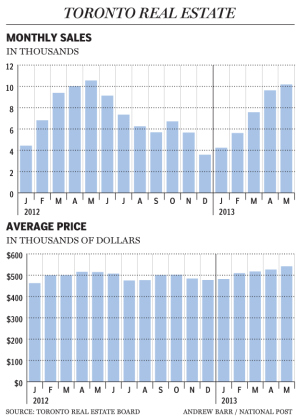
Home prices in Toronto, Canada’s most-populous city, rose 5.4% in May from a year ago, the biggest increase in five months, the Toronto Real Estate Board reported Wednesday. Statistics Canada said the value of April municipal building permits posted a 10.5% gain.

FP0606_TORONTO_real_estate_C_AB.jpgHousing-market data are showing few signs of a sharp correction even amid warnings from analysts and policy makers that a bubble may have been forming. Finance Minister Jim Flaherty tightened mortgage rules for a fourth time last year on concern that an overbuilding of condos could lead to sharp price declines. Former Bank of Canada Governor Mark Carney identified record household debt as the biggest domestic risk to the economy.

“The base case scenario is a soft landing,” said David Tulk, chief macro strategist at Toronto-Dominion Bank’s TD Securities in Toronto. “You’d have to see rates move dramatically higher” for a major correction, he said.

Driven by historically low interest rates, Canadian banks have been increasing dependence on real estate lending to drive earnings, with residential and non-residential mortgage assets totalling $955 billion at the end of March, or 26% of total assets, according to OSFI data. That’s up from $521 billion five years earlier, which represented 20% of assets at the time.

Fading Impact

The impact of Flaherty’s policy changes are beginning to fade, Toronto Real Estate Board President Ann Hannah said in Wednesday’s release.

“A growing number of households who put their decision to purchase on hold as a result of stricter lending guidelines are starting to become active again in the ownership market,” Hannah said.

The average sale price rose to $542,174, from $514,567 a year ago, while a composite home benchmark price index for the city was up 2.8%, the Toronto Real Estate Board reported. Unit sales dropped 3.4% from a year earlier to 10,182, the board said in an e-mailed statement Wednesday.

The decline in Toronto sales was led by condominiums and townhouses, while purchases of detached homes rose in May. Prices were up in all categories of homes.

On a year-to-date basis, Toronto sales are down 9.6%.

‘Weaker Volumes’

“The story continues to be one of weaker volumes,” Derek Holt, vice-president of economics at Toronto-based Scotiabank, said in a note to investors. “The question is how that will carry over into construction and prices.”

Residential building permits rose 21% to $4.35 billion in April, Statistics Canada said today, led by a 51.9% jump in condominium construction intentions.

Vancouver made one of the largest contributions to the national increase among 34 cities, Statistics Canada said, with permits rising 50.7% led by multifamily dwellings. Calgary permits also rose 40.6% to $773 million on commercial buildings.

Vancouver’s real estate board said Tuesday that home sales rose 1% in May from a year ago, with composite prices down 4.3%.

Falling home construction, which helped lift Canada’s economy out of recession, has been a drag on growth over the past year, shrinking at an annualized pace of 4.7% in the first quarter, according to GDP data released last week.

www.bloomberg.com

Enhanced by Zemanta

How Bond Yields Affect Fixed Mortgage Rates

First Time Buyers

Latest News

Mortgage Rates

Refinancing

Self Employed

How Bond Yields Affect Fixed Mortgage Rates

For those of you who are seeking to buy a home or if you’re considering refinancing your mortgage, then now might be the ideal time to do so.

Why? Vancouver mortgage brokers are keeping a close watch on what is happening with Canadian Government Bonds (GoC’s). The reason why GoC’s are important is because bond yields often have a direct impact on the direction of fixed mortgage pricing.

Just recently, Canada’s 5-year bond yield broached a 3-month high. The expectation of most Vancouver mortgage brokers is that the impact of these higher bond yields will also result in increased fixed mortgage rates.

The impact is already being felt as several mortgage lenders have already announced they are raising fixed mortgage rates 5-10 basis points higher on longer fixed mortgage terms. For those not familiar of what a basis point means then as a simple explanation 1 basis point is equivalent to 1/100 of a percent so 50 basis points for example would be equivalent to ½ %.

The Government of Canada 5 year bond yield has increased by 33 basis points in less than a month and is used by the mortgage industry as the pricing benchmark for determining fixed mortgage rates.

There are several reasons why this has occurred but it mainly stems from the rosier outlook which has transpired recently in the U.S. and abroad including:

  • Home prices which has seen risen by 10.9% and the highest increase in the past 7 years
  • Increased consumer confidence which is a 5-year high
  • Record high prices for the U.S. stock market
  • A diminished global risk perception (This generally results in lowering the demand for government bonds which are perceived as “safe”)

Bruce Coleman Vancouver Mortgage Broker

Bond markets have been rather bullish of late because of the global economic uncertainty but some analysts contend this might be coming to an end. These predictions should be taken with “a grain of salt” as they have made similar predictions before which didn’t pan out.

In any event, when it comes to a bullish bond market, even when the bond market cools it doesn’t necessarily mean it will suddenly reverse as it could just as easily stay flat and remain so for many years to come. Keep in mind that a bond yield will move in an inverse pattern to the bond price.

Another key factor which fuels bond yields and ultimately mortgage rates is the rate of inflation. The core inflation rate in Canada came in at a tepid 1.1% despite the fact that 2.0% was expected by the Bank of Canada. The low inflation rate was largely due to a weak GDP (Gross Domestic Product) and diminished gains on the employment front. It is not really certain that Canadian bond yields will continue to rise, but eventually you can expect that the higher bond yields will begin to fizzle out.

Most of the major economists in Canada have now changed their tune about the Bank of Canada making a rate change this year and now anticipate that it won’t happen until the latter part of 2014.

However, many Vancouver mortgage brokers are also aware this doesn’t mean that fixed mortgage rates won’t change now as they also usually increase well before the Bank of Canada raises its own rates.


SEO Powered By SEOPressor